Behind the Frosted Glass
No face-swapping. No scissors. No paste. Every slide aboard the Lab starts out in the field and ends up in the darkroom, finished one pixel at a time by the most dedicated, and most generously proportioned, ICU staff ever assembled: the nurses (and Gus) of the FakePics Image Care Unit, who moonlight as the Institute's roving field photographers. They haven't aged a day since 1957. (The older ones have actually grown a little younger, but it's rude to mention it.)
When they're not in the Lab, they're out in the field: county fairs, festivals, parades and anywhere else a crowd gathers, and lately any year a crowd gathers, press passes clipped on, shooting models on film from the Lab's own supply. The models are volunteers from the Ladies' Auxiliary, an endless supply of lovely ladies from every corner of the world; the staff themselves are mostly on the other side of the camera. Every roll comes home to the ICU Tensor Lab, the heart of the ship that fell into a Missouri cornfield in 1957 and adopted the staff as its crew. (It's bigger on the inside. Nobody called back about the paperwork.) The Lab itself does the developing. The nurses do everything else.
The work is exacting. Even our smallest image demands 262,144 pixels, each set into its precise position by high-speed tensor arm, and each chosen from a palette of 16,777,216 colors. That's a daunting task, even for a nurse with steady hands and good lighting. Today's slides run past three million pixels apiece. To date, the staff have shot and developed 35 slides, placing 76,267,520 pixels by tensor arm and logging 14 min in the darkroom. Nobody has asked for a raise. Nobody has been allowed to.
Pixels don't grow on trees. Ours are heirloom, non-GMO, cage-free and vegan, and freshly lab-grown: each one cultured from a single cell in a dish of warm growth medium, indoors, under glass, in a climate-controlled clean room. They are very small. You'd need a microscope. (The nurses have one.) In busy seasons the popular shades (flesh tones, mostly) run dangerously low, and the whole crew pitches in on the harvest.
Every pixel is sorted by color into the Supply Room: 16,777,216 labelled bins, one for every shade, shelved in aisles that go on for a very long way. Nothing goes to waste. Worn-out pixels are reclaimed from recycled pictures (the tired blacks and faded whites, mostly), the Lab's air filters pull a steady supply of greys out of the smog, the dust of forty star systems and the occasional passing nebula, and the loudest colors are melted down from the plastic Earth's recycling centers turn away. Every neon pink aboard used to be a drinking straw. Only the freshest colors, skin tones included, come straight from the culture dishes. The film stock is classified. Please stop asking.
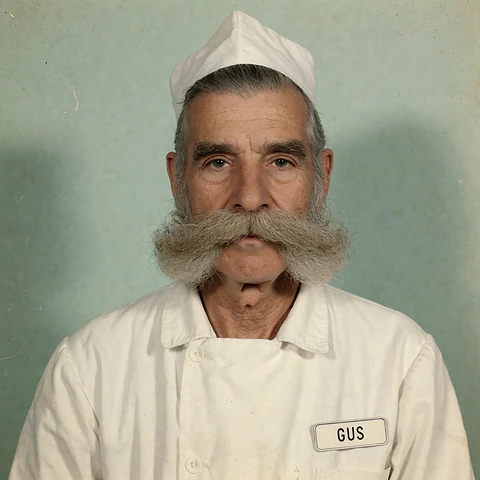
Then comes the Placement Room. Behind six inches of leaded glass, the nurses work the Mk. II High-Speed Tensor Placement Arms, one nurse to an arm. Every pixel rides up from its bin by pneumatic tube, is picked up with micro-tweezers and is set into the slide one at a time, at a good forty thousand pixels a second on a slow day. (That's why you mustn't tap on the glass.) Now and then one gets dropped, and Orderly Gus sweeps them up. He is not responsible for lost pixels.
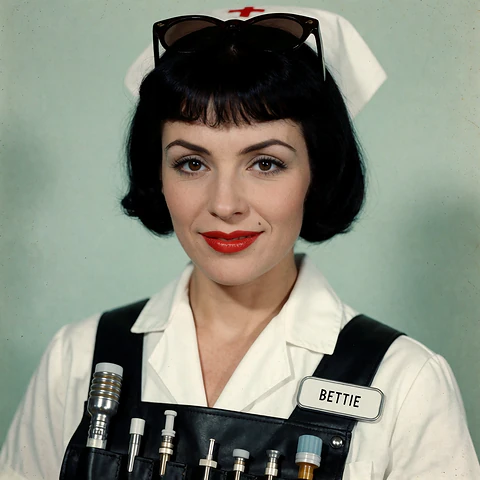
It's their ample tender loving care, their enormous artistic ability, their steady trigger fingers and their complete disregard for the company dress code that bring our fake images to life. Meet the staff below. Please do not tap on the glass, or the lens.
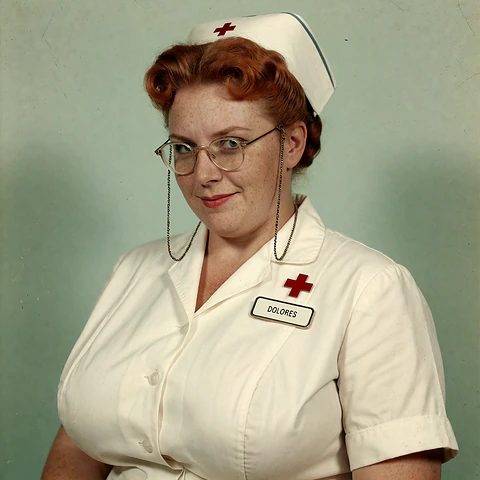 Nurse Dolores Pixley
Head Nurse, Night Shift
Field Photographer
Tensor Arm TPA-57-01
4 slides shot
Nurse Dolores Pixley
Head Nurse, Night Shift
Field Photographer
Tensor Arm TPA-57-01
4 slides shot